These are a few of our favorite things
Panelists highlighted recent papers with an impact on perioperative management and extended a reminder to regard results with a grain of salt.
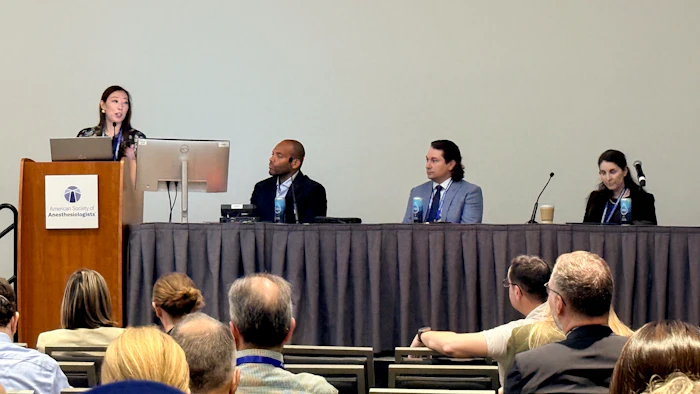
In the Sunday morning session “Our Favorite Papers of the Year: How Will They Affect Your Practice?” a panel of anesthesiologists rapid-fire reviewed late-breaking research with a focus on perioperative management. The session was moderated by Reney Henderson, MD, Associate Professor of Anesthesiology at the University of Maryland School of Medicine in Baltimore.
The three panelists synthesized evidence and presented practical takeaways from eight papers concentrating on delirium/cognition, critical care, and transfusion management.
Perioperative brain health
According to Leah Acker, MD, PhD, research on perioperative brain health published over the last year shifted foci to preexisting, latent vulnerability, and dynamic brain responses. Dr. Acker is an Associate Professor of Anesthesiology at Duke University School of Medicine in Durham, North Carolina.
A genome-wide association study, “Genetic Contributors to Postoperative Delirium and Their Implications for Dementia Outcomes,” identified a single locus associated with delirium: apolipoprotein E (APOE). Dr. Acker said this association with delirium indicates a strong relationship between delirium and dementia. A complementary study, “Cerebral Small-Vessel Disease and Postoperative Delirium in Elderly Noncardiac Surgical Patients,” concluded that the more markers a patient has for cerebral small-vessel disease or perivascular abnormalities, the higher their risk of postoperative delirium (POD) or cognitive impairment.
“If you have a patient with known dementia or vascular delirium, what prophylactic or supportive measures can you take?” she asked. “Because these are really high-hazard ratios.”
Dr. Acker referenced a paper, “Electroencephalographic Monitoring in the Recovery Room for Identification of Patients at Risk for Postoperative Delirium,” that considered the benefits of using electroencephalographic monitoring (EEG) in the PACU or ICU to analyze dynamic brain responses and identify patients at risk of POD. Of the patients whose EEG images were sufficient to analyze, 37% experienced POD. These patients showed preserved spectral patterns (versus baseline) across all frequency bands in comparison to patients without POD.
Dr. Acker also touched on a clinical trial, “Effect of S-Ketamine on Postoperative Delirium in Elderly Patients Undergoing Arthroplasty: A Randomized Controlled Trial,” that evaluated ketamine as a possible delirium intervention. Its conclusion was that S-ketamine has potential to reduce the risk of POD when administered in bolus I.V. perioperatively (with an additional dose given postoperatively with PCIA) and without general anesthesia (regional was fine). Patients who received ketamine experienced side effects like hallucinations and nightmares, but the rate of delirium in the first three postoperative days was 8%, compared to 20% of patients who received placebo. Dr. Acker’s conclusion?
“I think we need to do less of saying ketamine is good or ketamine is bad and more of looking at the individual patient and evaluating the best approach.”
Critical care
Paul Gallo, MD, Assistant Professor of Anesthesiology at the University of Virginia in Charlottesville, shared a unique perspective from his critical care fellowship days, when COVID-19 took hold. Although he has a preferred anesthesia cocktail and type of laryngoscope, he quickly learned that being familiar with everything was, in fact, critical to daily practice.
“All [analgesic agents] have pluses and minuses, but it’s important that anesthesiologists are comfortable with all of them, because you never know what will go on shortage tomorrow,” he said. “The same applies to all the tools in your cart. Nothing is perfect.”
Dr. Gallo examined two studies: “Ketamine or Etomidate for Tracheal Intubation of Critically Ill Adults,” and “Hemodynamic Response to Intubation With 4 Different Laryngoscopes in Coronary Artery Bypass Graft Surgery: A Randomized Trial.” In both cases, there weren’t any differences in primary outcomes that supported one analgesic or blade over another. Although, in the latter study, researchers did observe the Macintosh had the shortest intubation time and the EZVision had the longest intubation time.
What Dr. Gallo did find upon closer inspection was that the patients in the laryngoscope trial were given anesthesia amounts so copious that they weren’t realistic in everyday practice. “How could patients’ heart rate or blood pressure change if they are hammered with anesthesia,” he joked with attendees. This, he said, tells a cautionary tale for physicians.
“It’s so easy in the social media era to look at a headline, jump to a conclusion, and move on,” he said. “I want to iterate that you have to continue to read literature critically.”
Transfusion management
In addition to reading the fine print, the presenters agreed it’s important to reflect on what a study’s impact has on personal practice and patient care.
“We have to focus on what these results might mean when we’re making our critical decisions,” said Jaclyn Mueller, MD, Assistant Professor of Anesthesiology at the University of Maryland.
In both papers Dr. Mueller presented, the real-life clinical benefits were questionable. The first was “Restrictive vs. Liberal Transfusion Strategy After Myocardial Infarction: A Post Hoc Analysis of the MINT Randomized Clinical Trial.” It evaluated a restrictive strategy (transfusion permitted below 8 g/dL and strongly recommended below 7 g/dL) versus a liberal strategy (transfusion to maintain hemoglobin greater than 10 g/dL) in patients who had acute myocardial infarction with anemia. Although the authors determined the results leaned toward liberal transfusion, indicating ischemic benefit was likely greater than the risk of heart failure, they were not statistically significant. The re-analysis, therefore, doesn’t justify one particular transfusion strategy for every patient.
“Liberal isn’t always right, and restrictive isn’t always right,” said the moderator, Dr. Henderson. “That’s why we have to do our jobs as clinicians to make critical decisions.”
Dr. Mueller also referenced, “Intravenous Iron to Treat Anaemia Before Cardiac Surgery (ITACS): International, Double Blind, Placebo Controlled Randomised Trial.” That paper looked at elective cardiac surgery and whether an early intervention of preoperative I.V. iron could reduce the need for transfusion. Again, the results failed to find a statistically significant difference in methods.
What now?
The session may have been a lightning round examination of published papers and analysis, but the ensuing discussion was engaging and thoughtful. The panel provided valuable advice when considering how to apply these – and all – study outcomes to clinical practice.
“We’re limited by these studies that have to be more general to give us guidelines or parameters; they all have pluses and minuses,” Dr. Mueller said. “But since our decisions are happening in real-time at the bedside, that’s where we can really tailor and personalize care.”
Dr. Gallo added to this sentiment: “[Medicine] is a pendulum, and in some ways, we swing toward ERAS and recipes for treating all patients. I hope to see the pendulum start to swing back a little where we can tailor and fine-tune the recipe for Mr. Smith who is in front of us.”
In agreement, Dr. Acker said the continued advancements in artificial intelligence provide anesthesiologists with real-world data nearly every minute, allowing them to consider the heavily phenotyped patient at arm’s length and make informed decisions based on research and guidelines.