Try, try, try again, then triumph
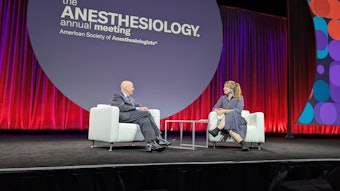
Through inspiration and laughter, Opening Session presenters James Rathmell, MD, and Will Flanary, MD (Dr. Glaucomflecken), spread a message that medicine is rooted in advocacy, vigilance, and a healthy dose of pushing the envelope.
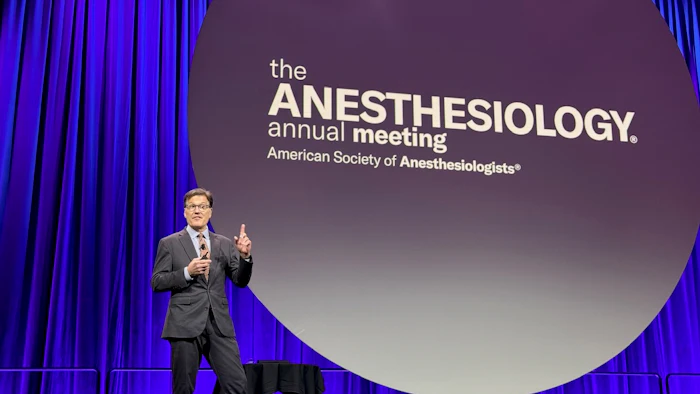
The ANESTHESIOLOGY 2026 Opening Session touched on life’s ups and downs through laughs and lessons. Saturday’s Emery A. Rovenstine Lecture and keynote presentation shared a common theme of resilience in the face of adversity and the importance of being an advocate for oneself, one’s patients, and one’s specialty for the greater good of healthcare.
ASA President Patrick Giam, MD, FASA, introduced James P. Rathmell, MD, who delivered the Rovenstine Lecture: “Reinvention, Stewardship, and the Making of an Anesthesiologist.” Dr. Rathmell is Chair of the Department of Anesthesiology, Perioperative, and Pain Medicine at Brigham & Women’s Hospital in Boston, Leroy D. Vandam Distinguished Professor of Anesthesia at Harvard Medical School, and Editor-in-Chief of Anesthesiology.
Taking the road less traveled
In his lecture, Dr. Rathmell reflected on his circuitous path to anesthesiology, which began with aspirations of oncology then ophthalmology. He admitted to attendees that his career hit bumps in the road, but perseverance and curiosity eventually led him to a life he wouldn’t trade for anything.
Early out of residency and fueled by ambition, Dr. Rathmell accepted a position that he admitted he wasn’t ready for. So, he took a step back and decided to reinvent and reimagine what he really wanted out of his profession. He decided to let his curiosity take the lead.
He said he was fortunate to receive time and space to pursue his interest in cervical transforaminal steroid injections, a road he followed for more than a decade. Dr. Rathmell credited this to the power of mentorship.
“When you find something you’re curious about that doesn’t feel right, pursue it, research it. Other people made room for my reinvention along the way,” he said.
Mentorship naturally leads into stewardship. Supporting the next generation of leaders and the next amazing inventions is foundational to the future of anesthesia, Dr. Rathmell said. This requires giving people time and finances to grow, learn, and innovate. He challenged ASA members to pay this forward.
“Who will protect the time required to follow the next question? Who is someone that you’re in a position to help now, and what will you make possible for that person?” he asked.
Dr. Rathmell also encouraged members to look at medicine through a new lens. He did this when he became Executive Editor, and later Editor-in-Chief, of Anesthesiology and dove into the process of designing the monthly journal’s cover images. Spending 100% of working time in the operating room doesn’t allow you to see the bigger picture or to step back and develop theories and teach those alongside you, he said.
Many times throughout his life, Dr. Rathmell said he thought of “The Road Not Taken,” by Robert Frost, and shared an honest takeaway.
“It’s not the road you take – it’s what you do with the choice you made,” he said. “You make a choice and then you forge forward.”
Turning heartbreak into humor
Speaking of choices, keynote speaker William Flanary, MD, had to make several hard choices throughout his life that certainly left an impact. Perhaps better known as Dr. Glaucomflecken, he has a unique perspective on healthcare as both a physician (ophthalmologist) and a patient (he has survived cancer twice and sudden cardiac arrest).
Dr. Flanary said he was always a bit of a jokester, but after deciding to pursue medicine, he never anticipated adding “stand-up comic” to his résumé. But humor, he said, gave him resilience to cope with difficult circumstances.
Along the way, he discovered his social media platform could reach more people if he addressed the elephant(s) in the room. Will Flanary, MD, (a.k.a. Dr. Glaucomflecken).
“How can you fix the problems in healthcare if you don’t know what the problems are?” he asked rhetorically.
This new angle on comedy, which partly grew out of frustration from insurance billing, hit home to those who’d had the same experience. Dr. Flanary said he saw it as an opportunity for advocacy.
From then on, he has worked to bridge the gap between physician knowledge about the healthcare system and the public’s knowledge, or lack thereof. This includes patients, caregivers, and politicians.
Humor is still at the heart of most of his communications, though. Dr. Flanary has loads of inside jokes about the medical community, including anesthesiologists, who, he said, provide endless light-hearted fodder. For example, when he began research for his presentation, the first article he found was how power naps might improve clinical performance in anesthesiologists. He also referenced an early blog he wrote titled, “Pathetic anesthesiologist can’t even put own kids to sleep.” These really broke the ice for the anesthesiology crowd.
Dr. Flanary addressed the power of social media head-on. According to a study, one in five Americans uses TikTok for medical information before consulting their physician. Equally horrifying, he said, is that social media posts that contain misinformation can spread up to 28 times faster than factual ones.
In the face of backlash on social media, he suggested it’s better to let it go than continue to fester, or you risk repercussions like the “Streisand effect.” Based on real-world experience, his advice was to “focus on the message and the people who support you.”
Luckily, Dr. Glaucomflecken and his co-creator wife, Kristin (a.k.a., Lady Glaucomflecken), worked with ASA to create a social media guide to help anesthesiologists amplify their voice. Download your copy of the Glaucomfleckens’ Medical Creator Manual.