ANESTHESIOLOGY Daily News
  • Meeting Info
  • Sessions
  • Claim CME
ANESTHESIOLOGY Daily News
Day
Friday
Saturday
Sunday
Monday
Tuesday
Topics
Ambulatory Anesthesia
Cardiac Anesthesia
Fundamentals of Anesthesiology
Geriatric Anesthesia
Neuroanesthesia
Obstetric Anesthesia
Pain Medicine
Pediatric Anesthesia
Perioperative Medicine
Physician Well-Being & Burnout
Professional Issues
Regional Anesthesia & Acute Pain
Safety & Quality
Technology
Workforce Shortages
Archive
2025
2024
2023
2022
2021
2015-2020
Resources
  • Meeting Info
  • Sessions
  • Claim CME
Topics
  • Ambulatory Anesthesia
  • Cardiac Anesthesia
  • Fundamentals of Anesthesiology
  • Geriatric Anesthesia
  • Neuroanesthesia
  • Obstetric Anesthesia
  • Pain Medicine
  • Pediatric Anesthesia
  • Perioperative Medicine
  • Physician Well-Being & Burnout
  • Professional Issues
  • Regional Anesthesia & Acute Pain
  • Safety & Quality
  • Technology
  • Workforce Shortages
By Day
  • Friday
  • Saturday
  • Sunday
  • Monday
  • Tuesday
Archive
  • 2025
  • 2024
  • 2023
  • 2022
  • 2021
  • 2015-2020
Facebook iconTwitter X icon LinkedIn iconInstagram iconBluesky
Oct 20th, 2026

Shining the spotlight on blood

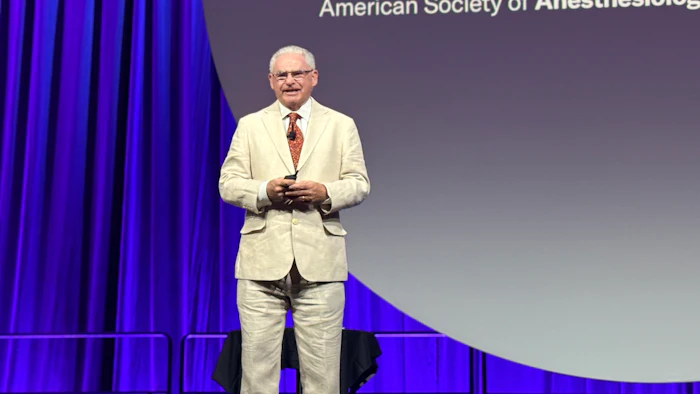
Severinghaus lecturer Bruce D. Spiess, MD, FAHA, displayed his remarkable research on blood and how it applies to anesthesiology.

Presenter in cream suit speaking at podium during American Society of Anesthesiologists annual meeting with purple curtains and blue stage backdrop
Bruce D. Spiess, MD, FAHA.

Blood is a vital, complex organ – and don’t tell Bruce D. Spiess, MD, FAHA, otherwise. Dr. Spiess, who is Professor Emeritus in the Department of Anesthesiology at the University of Florida in Gainesville, delivered the John W. Severinghaus Lecture on Monday morning.

His presentation featured revolutionary research performed by him, multiple colleagues like Dr. Robert Winslow and Dr. Thomas Hornbein, and Dr. Severinghaus himself. Dr. Spiess even referred back to the 16th century to recognize the progressive, foundational work of Leonardo da Vinci, who dissected a human cadaver, from its aorta to capillaries, to illustrate and describe blood vessel anatomy.

Dr. Spiess admitted he was reluctant to become a researcher early on but said, “It’s become one of the most wonderful, joyful experiences I’ve traversed in life.” He also shared how much of an honor it was to be associated with Dr. Severinghaus, whom he highly regarded.

Much of Dr. Spiess’ research has focused on perfluorocarbon (PFC) oxygen therapeutics. A Japanese researcher who wrote on the topic incited this quest, he said, particularly this statement: “Everyone here should realize that PFCs make not only oxygen fully soluble in blood but nitrogen and all other respiratory gases.”

He was also inspired by his dad, Elliott, an evolutionary geneticist, who said, “One cannot understand biology (medicine) without evolutionary context.” So that’s what Dr. Spiess did – he looked at how hemoglobin evolved to carry oxygen and how closely similar it is to the function of chlorophyll in plants.

Highlights of his career, Dr. Spiess said, include working with the U.S. Navy on treating decompression sickness with hyperbaric oxygen therapy. He also collaborated with the U.S. Army to train special operations combat medics, like green berets, on using critical oxygen delivery on the battlefield to treat trauma-induced coagulopathy.

Dr. Spiess also revealed he had created a new word that better addresses the biocomplexity of blood: sanguothelium. “Sanguis” is Latin for blood, and the sanguothelium, he emphasized, is a vital organ. It is anthropomorphic in that it doesn’t have one single, significant function. In fact, it is an organ that all other human organs depend on, and it supports whole blood health. He said it’s extra important to anesthesiologists, who administer more than 50% of the blood in the U.S. – which quantifies to 11-14 million RBC units/year.

Knowing all this, Dr. Spiess said the medical and scientific communities cannot continue to simplify blood to one specific thing: hemoglobin. Rather, they need to “embrace the biocomplexity of blood,” which he said contains more than 2,800 proteins.

Other applications for PFC oxygen delivery (diffusion) when there is low to no flow of plasma, he said, are cardiac arrest, stroke, traumatic brain injury, spinal cord trauma and surgery, and solid-tumor cancer immunotherapy. Within cardiac surgery, he said research shows that PFC added to cardiopulmonary bypass prime reduces cerebral air emboli by 98%.

Dr. Spiess challenged anesthesiologists to continue in his research footsteps, especially as it relates to blood transfusions. Ordering a blood transfusion based on hemoglobin levels is not physiologic, he said, because there is no proven threshold.

“Tissue oxygen supply is not hemoglobin-dependent until extremely low levels.” Levels, he said, haven’t been met in randomized controlled trials evaluating restrictive versus limited transfusions.

Everything anesthesiologists do is based on macrocirculation, said Dr. Spiess. But anesthesiologists need to focus on microcirculation and develop a tool to measure it. “This,” he said, “is the business-end of where things happen.”

Dr. Spiess’ enthusiasm and dedication were on full display throughout his presentation and will surely be remembered far beyond the annual meeting.

From The ASA Monitor
Congratulations to the 2026 Excellence in Research and Presidential Scholar Award Winners
The Grassroots Battle is Won by Those Who Show Up
CAPE: Moving from Economic Policy Groundwork to Strategic Action
Making a Dent in the Academic Universe
Mark A. Warner, MD, to Present ‘Evolution of the Anesthesia Patient Safety Movement in America’
Central Line Inside the Monitor Podcast – Advocacy: Our Future Is in Our Hands
More Content
Three professional headshots of diverse individuals on blue background
Home
Artificial intelligence, real applications
Oct 20th, 2026
Two professionals wearing conference badges sit at a table during a business meeting or networking event
Home
Creating a better work environment
Oct 19th, 2026
Three professional headshots of diverse individuals smiling against colored backgrounds
Home
From friction to new product
Oct 19th, 2026
Three professionals seated on white chairs at a conference panel discussion event
Pain Medicine
Fighting the good fight in the opioid epidemic
Oct 19th, 2026
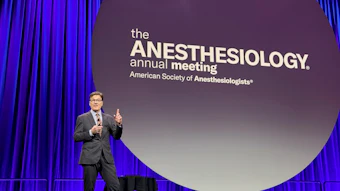
Speaker presenting at the Anesthesiology annual meeting with ASA logo displayed on large screen behind him
Professional Issues
Try, try, try again, then triumph
Oct 18th, 2026
Three professional headshots of men with different backgrounds and styling
Home
LITES research network findings signal potential changes in trauma resuscitation strategies
Oct 18th, 2026
Two professional headshot portraits of men in business attire smiling at camera
Fundamentals of Anesthesiology
Recognizing research in anesthesiology
Oct 18th, 2026
Four professional headshots of individuals displayed in a grid layout against a blue background
Fundamentals of Anesthesiology
What’s old is new – or relevant – again
Oct 17th, 2026
Two professional headshots of men in business attire against blue and outdoor backgrounds
Fundamentals of Anesthesiology
Nerve stimulation could reduce postsurgical pain and opioid use
Oct 17th, 2026
Professional headshot of a man wearing glasses and dark blazer with blue tie
Fundamentals of Anesthesiology
FAER-Helrich Research Lecture: ‘The Prepared Mind’
Oct 16th, 2026
Professional portrait of a smiling woman with white hair wearing a black blazer and blue shirt in a park setting
Fundamentals of Anesthesiology
The call for a system-wide approach to improve high-risk surgical patient outcomes
Oct 16th, 2026
Speaker presenting at Anesthesiology Annual Meeting on dark stage with red curtains
ANES25
Rovenstine Lecture: Harnessing data to improve quality of care
Oct 14th, 2025
ANESTHESIOLOGY Daily News
© 2026 American Society of Anesthesiologists (ASA)
1061 American Lane | Schaumburg, IL 60173