Innovative approaches to advancing perioperative care
Annual symposium tracks technology, drug development, palliative care, and more.

Groundbreaking developments in perioperative medicine will be on full display during the 34th Journal Symposium. Sponsored by Anesthesiology, this year’s theme centers on innovation — spanning new technologies, drug development, pain management, and palliative care — all aimed at transforming patient outcomes before, during, and after surgery.
The 2025 session “34th Journal Symposium: Innovations in Perioperative Medicine” highlighted emerging and important concepts in anesthesia research and clinical practice.
“Innovation is crucial for there to be advances in improving patient care. Innovative ideas and findings require collaboration and development to be translated into better care,” said Anesthesiology Deputy Editor Andrew Davidson, MBBS, MD. “The symposium is a recognized forum where early researchers at any stage in their career or from any corner of the world can start that journey of translation.”
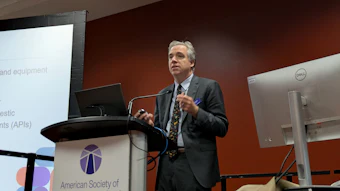
Steven Shafer, MD, FASA, Emeritus Professor of Anesthesiology at Stanford University in Stanford, California, is among the session panelists. His presentation “Chutes and Ladders in Drug Development” showcased the clinical pharmacology of anesthetic drugs, exploring both scientific breakthroughs and systemic obstacles.
Those obstacles, he said, are born from anesthesiologists’ resistance to change, high drug development costs and regulatory hurdles, skepticism from pharmacies and the FDA, and biological unpredictability in drug efficacy.
“Anesthesiologists are creatures of habit, and don’t readily embrace new [drug development]. Two examples are remimazolam and oliceridine,” Dr. Shafer said. “Remimazolam is a potentially game-changing drug. However, sales in the U.S. are roughly zero. Anesthesiologists are very happy with propofol and are not interested in exploring how remimazolam might transform clinical practice (specifically, permitting patients to drive home after receiving sedation).”
Additionally, Dr. Shafer said oliceridine has theoretical benefits over fentanyl. It, too, has sales of nearly zero, because most anesthesiologists who are trained and experienced in using fentanyl see no reason to use another drug.
Dr. Shafer emphasized the gap between scientific promise and clinical implementation, urging clinicians to stay informed while recognizing the challenges of commercialization.
“I’ve been involved with multiple startups for perioperative drug development. All have been successful developing highly novel compounds with safety and efficacy demonstrated in both animal and human studies,” Dr. Shafer said. “However, they eventually failed because nothing reaches the market unless big pharma picks up the drug.”
Among the highlights at the 2025 symposium was a look at perioperative palliative care. Rebecca A. Aslakson, MD, PhD, Professor of Anesthesiology at the University of Vermont Larner College of Medicine in Burlington, presented “New Concepts in Perioperative Palliative Medicine.” Dr. Aslakson plans to discuss a 2024 article published in Anesthesiology proposing a structured approach to managing patients with preexisting treatment limitations like do-not-resuscitate (DNR) and do-not-intubate (DNI) orders. She also discussed evidence supporting the effectiveness of video-based palliative care visits, which may offer practical benefits for preoperative planning, and the results from two randomized controlled trials of perioperative palliative care in surgical populations.
In noting the 2024 article, Dr. Aslakson hailed a revised approach for addressing perioperative management of patients with preexisting treatment limitations, such as a preoperative DNR/DNI status. Previously, ASA recommended “required reconsideration,” which is a preoperative discussion with the patient about their code status and whether it should be changed during the perioperative period. The new approach advocates for evaluating the alignment of a patient’s advance directive with their perioperative care needs alongside the implications of perioperative complications for their postoperative course.
“It’s important to partner with surgeons, primary care physicians, palliative care teams, geriatricians, and other members of your health care system to build preoperative assessment systems and teams that can help to optimize and advise patients at potential high risk for postoperative poor outcomes, particularly for those that present with preoperative DNR/DNI treatment limitations,” Dr. Aslakson said.
Dr. Aslakson also described two studies presented at the 2025 Annual Assembly of the American Academy of Hospice and Palliative Medicine, which summarized the most impactful research in perioperative palliative care over the last two years. The studies support the feasibility of perioperative subspecialist-delivered palliative care, saying it is “practically possible, resulted in no harm, and was accepted and valued by patients and surgical teams,” she said.
Other presentations include:
- Perioperative Technology, by Maxime Cannesson, MD, PhD
- Preoperative Planning and Optimization, by Stephen Esper, MD
- Acute and Chronic Pain Management, by Kristin Schreiber, MD, PhD
There were also discussions with the authors of multiple studies.
The session was moderated by Anesthesiology Editors Brian Bateman, MD, and Peter Nagele, MD, MSc.